Bedding Materials Guide
Silk Sheet Weaves Explained: A Gingerlily Material Guide
Silk bedding is often described in a handful of appealing words: smooth, cool, luminous. But the details behind that first impression matter. Fiber, fabric weight, construction, fit and care all shape how sheets feel in daily use—and whether they suit your bedroom routine.
Here’s a practical guide to reading the labels on mulberry silk sheets, including what momme weight can tell you, how to think about weave and finish, and why fitted-sheet pocket depth deserves a place on your checklist. We’ll also look at the care requirements associated with Gingerlily silk bedding so you can make a considered choice rather than relying on a single headline claim.
First, a useful distinction: fiber, weave and weight
When comparing sheets, it helps to separate three ideas that are easily blurred together. Fiber describes the material itself—for example, 100% mulberry silk. Weave describes how the yarns are interlaced to create the fabric. Weight describes how much silk is used in a given area, often expressed for silk fabric in momme.
These characteristics are related, but they are not interchangeable. Two sheets may both be made from mulberry silk yet differ in weight, finish, drape and how substantial they feel. A product listing may identify the silk type and momme weight while offering little detail about the exact weave. In that case, avoid guessing: use the information provided, and treat unanswered construction questions as questions for the seller or product label.
Thread count is another familiar bedding measure, but it is not a universal shortcut for comparing different fibers. The number most commonly used for cotton does not explain silk’s weight or hand. For silk sheets, the material, momme figure, construction details and care instructions are more useful starting points.
What does momme mean on silk sheets?
Momme, commonly abbreviated as “mm,” is a traditional unit used to describe the weight of silk fabric. In practical terms, it gives shoppers a way to compare the substance of silk textiles. A higher momme figure generally indicates more silk by weight in the fabric, though the number alone cannot tell you everything about softness, finish or durability.
Gingerlily sheet details supplied for this guide include silk fitted sheets at 19 momme and 22 momme. Both are described as 100% mulberry silk. The 19-momme Blush Silk Fitted Sheet has a listed 15-inch pocket depth, while the Silver Grey and Summerhill Blue fitted sheets are listed at 22 momme. These specifications provide a useful basis for comparison, but they do not mean one weight is automatically right for every sleeper.
A lighter-feeling sheet may appeal if you prefer a fluid, delicate drape. A higher momme figure may be worth considering if you want a more substantial fabric. Individual perception varies, and the finished feel is also influenced by the weave, finishing and how the bedding is cared for. If you can’t handle the fabric in person, product specifications and clear return terms can help you decide with realistic expectations.
- Use momme to compare fabric weight. It is more relevant to silk than cotton thread count.
- Don’t treat a higher number as a guarantee. The figure does not independently establish quality, softness or lifespan.
- Compare like with like. Check that the listed item is a sheet, and not a pillowcase or duvet cover, before drawing conclusions.
- Consider the whole specification. Fiber content, fit, care and construction all affect everyday satisfaction.
For a simple example of how product details can clarify the material, the Gingerlily Blush Silk Fitted Sheet is listed as 100% mulberry silk at 19 momme, with a 15-inch pocket depth. The Silver Grey Silk Fitted Sheet is listed at 22 momme and also has a 15-inch pocket depth. Those are concrete points to compare; claims about how either will feel on your own bed remain personal.
Silk weave: what labels do—and don’t—tell you
Weave affects a fabric’s surface, drape and appearance. Satin, for instance, refers to a weave structure that can create a smooth face with a subtle sheen. “Charmeuse” is commonly used for a lightweight satin-woven silk fabric. These terms can help describe the character of a textile, but a product listing should specify the construction if you want to rely on it.
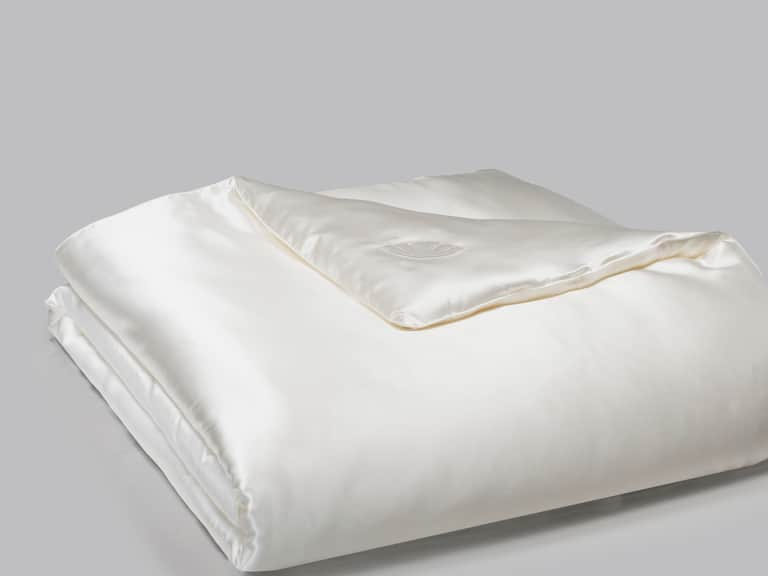
Not every Gingerlily sheet description in the available details names a weave. The fitted-sheet listings identify mulberry silk and momme weight, while the Ivory Silk Duvet Cover is described as 19-momme mulberry silk with a 3-inch border and button closure. A duvet cover is not a sheet, of course, but its specifications illustrate why it is worth reading each product’s own description rather than assuming every piece in a collection has identical construction.
When a sheet listing doesn’t state the weave, it is safest to leave that detail open. Ask whether the fabric is satin-woven or made using another construction, and whether the stated weight refers to the finished fabric. A transparent answer is more helpful than a confident-sounding guess based on the word “silk.”
Silk’s smooth surface is one reason it is often chosen for bedding. It can feel cool to the touch at first, but the sensation changes with room temperature, skin temperature, humidity, and the layers on the bed. “Cool” should be understood as a tactile impression and a feature of the sleep setup, not a promise that a sheet will lower body temperature or solve overheating.
Mulberry silk: look for the content, not just the name
Mulberry silk is produced by silkworms raised on a controlled diet of mulberry leaves. For a shopper, however, the most important point is not the botanical story: it is the product’s stated fiber content and the clarity of its specifications. A listing that says “100% mulberry silk” gives a different material description from one that says “silk blend” or identifies silk only as a surface fabric.
That distinction matters because bedding sets can combine different materials across the sheet, shell and fill. Check the item you are buying rather than assuming that a matching color or collection name means every piece has the same fiber composition. If the product is a fitted sheet, look specifically for the fitted sheet’s material statement, not just a general description of a wider bedding range.
Silk is a natural fiber, but natural does not mean maintenance-free or suitable for everyone. Some people enjoy its smoothness and drape; others may prefer the familiar, more straightforward routine of cotton. The best material is the one that feels comfortable to you and fits the care habits you are willing to maintain.
The fitted-sheet detail that can make or break the fit
A sheet’s material can be lovely, yet an unsuitable fit can undo the pleasure quickly. For a fitted sheet, check the pocket depth against the full height of your mattress, including any topper or mattress pad that stays in place overnight. A sheet that is too shallow may pull loose at the corners; one with excess fabric may wrinkle or feel less secure.
Gingerlily’s Blush and Silver Grey fitted-sheet details list a 15-inch pocket depth. The Summerhill Blue Silk Fitted Sheet lists a 35-centimetre pocket depth. These measurements are close but not identical, so compare them with the actual mattress height and the bedding item you plan to use. If you use a thick topper, measure the combined height rather than the mattress alone.
Also check the size label—such as Twin, Queen or King—and confirm the retailer’s size chart. Mattress dimensions can vary by country and manufacturer, and a nominal size is not always enough to guarantee a secure fit. If the sheet uses elastic, look for information about its placement and coverage when available.
- Measure the mattress from its base to the top surface.
- Include a topper or pad if it remains on the bed under the sheet.
- Compare the measurement with the listed pocket depth, allowing for a secure tuck.
- Check the sheet size and the retailer’s sizing guidance before ordering.
A realistic look at silk sheet care
Care is part of the material decision, not an afterthought. The Gingerlily fitted-sheet listings provide delicate-cycle washing guidance at no more than 30°C, followed by air-drying. Some also recommend a mild liquid silk detergent and a cool iron if needed. Always follow the current care label on the exact item you own, since instructions can differ by product and may be updated.
Before washing, check that the machine is suitable for delicate items and avoid overloading it. Use a detergent intended for delicate fabrics if the label recommends one. Strong agitation, harsh cleaning products, high heat and rough handling can put unnecessary stress on fine textiles. When in doubt, use the gentlest method allowed by the care instructions or contact the manufacturer for clarification.
Air-drying is a practical way to avoid high dryer temperatures, but take care with direct sunlight and handling. Lay the sheet or hang it according to the care label, supporting the fabric so it does not stretch under its own weight. If ironing is permitted, use the stated cool setting and avoid applying more heat than necessary.
Silk bedding may need a more considered laundry routine than some everyday cotton sheets. That does not make it difficult for everyone, but it is worth being honest about your habits. If bedding goes straight into a hot wash and high-heat dryer every week, a delicate fiber may not be the most convenient match. A realistic maintenance plan is part of choosing a sheet you will continue to enjoy.
What silk can contribute to a sleep setup
A sheet is one part of a larger sleep environment. Room temperature, humidity, pajamas, the mattress, blankets and personal preference all affect comfort. Silk is often appreciated for a smooth hand and a breathable feel, but no textile can compensate for an overly warm room, a poor mattress fit or a sleep schedule that doesn’t suit your needs.
People who are sensitive to surface texture may value silk’s smoothness. Others may prefer the crisp, matte feel of percale cotton, or the warmer hand of a brushed fabric. If you are comparing materials, think about the sensation you like when you first get into bed and how the sheet feels after several hours, not only how it looks on a neatly made bed.
Claims about skin, hair or allergies deserve careful reading. A smooth surface may reduce friction compared with a rougher textile, but that does not make silk a treatment for skin or hair conditions. Likewise, a product description’s hypoallergenic wording is not a guarantee that every person with allergies will have no reaction. If you have a known sensitivity, review the full fiber and dye information and seek medical guidance where appropriate.
For broader bedding comparisons, separate comfort from health claims. A material can be pleasant without being therapeutic. The most dependable test is whether the sheet suits your body, bedroom conditions and laundry routine over time.
How to assess Gingerlily sheet details
Product descriptions are most useful when read as a set of practical facts rather than a collection of adjectives. When comparing Gingerlily sheets, use a short checklist and record the answers side by side. It makes differences easier to see and helps prevent a single feature—such as sheen or a higher momme number—from dominating the decision.
- Confirm the product type. Make sure you are comparing fitted sheets with fitted sheets, not duvet covers or pillowcases.
- Check fiber content. Look for a clear statement such as 100% mulberry silk.
- Note the momme weight. Treat it as a fabric-weight reference, not a standalone quality score.
- Look for weave and finish information. If it is absent, ask rather than infer.
- Measure pocket depth. Include any topper or pad in your mattress measurement.
- Read the care instructions. Consider whether delicate washing and air-drying suit your routine.
- Check the exact size and return policy. Fit and personal feel can be difficult to judge from a description alone.
The Silver Grey Silk Fitted Sheet is listed as 100% mulberry silk, 22 momme, with a 15-inch pocket depth and delicate-cycle care instructions. The Summerhill Blue Silk Fitted Sheet is also listed as 100% mulberry silk at 22 momme, with a 35-centimetre pocket depth. These details invite a straightforward comparison while leaving room for the preferences that only an individual sleeper can judge.
Common silk-sheet assumptions, gently corrected
“A higher momme number is always better.”
Not necessarily. A higher number indicates greater fabric weight, but the right choice depends on how substantial a sheet you prefer, how you use it and what the rest of the construction is like. “Better” is personal, not a mathematical conclusion.
“Thread count tells me whether silk is good.”
Thread count is not the best single comparison tool for silk. Read the fiber content, momme weight, weave details and care label instead.
“Silk always feels cold.”
Silk may feel cool when you first touch it, but its sensation changes with the room and the person using it. It is not a fixed-temperature surface or a substitute for a comfortable bedroom climate.
“Delicate care means the sheet is impractical.”
It means the care routine deserves attention. Some households are comfortable with a gentle wash and air-drying; others would rather choose a fabric that tolerates a simpler laundry cycle. Neither preference is wrong.
“Every piece in a silk collection has identical specifications.”
Collections can include different fabric weights, colors, closures and care needs. Check each item’s own description, especially when mixing fitted sheets, pillowcases and duvet covers.
Choosing by sleep preference, not by label alone
If you tend to sleep warm, you may be drawn to silk’s light drape and breathable feel. Still, the sheet’s weight is only one factor among several: room temperature, duvet insulation and sleepwear can all make a larger difference. Consider how you currently feel at night before assuming a material change will solve the problem.
If you want a more substantial sheet, compare the listed momme figures and look for specific weave information. A higher figure may be a useful point of comparison, but it does not promise a particular level of softness or durability. Ask for clarification if the specification you care about is missing.
If your priority is simple maintenance, put care instructions near the top of the decision list. Silk’s appeal may be immediate, but the relationship is a long one: washing, drying, storage and everyday handling determine whether the textile fits into your home comfortably.
And if you are still unsure, start with the practical questions: Does the sheet fit your mattress? Do you like the stated weight and feel? Can you follow the care guidance? Those answers are more useful than buying based on a promise that one fiber is perfect for everyone.
The bottom line
Silk sheets are not defined by one number. Fiber content tells you what the fabric is made from; weave helps explain its surface and drape; momme gives a reference for weight; and pocket depth determines whether a fitted sheet is likely to stay in place. Care instructions show what everyday ownership asks of you.
For Gingerlily sheets, the listed fitted-sheet details provide useful comparison points: 19- or 22-momme mulberry silk options, pocket depths stated in inches or centimetres, and delicate washing with air-drying guidance. Read each product’s specifications individually, measure your mattress carefully and be realistic about how much care you are willing to give a fine textile.
The best sheet is not necessarily the one with the most impressive description. It is the one that fits, feels right to you and works with the way you actually live—night after night, laundry day after laundry day.
Quick checklist before choosing silk sheets
- Verify that the item is a sheet and check its exact fiber content.
- Compare momme weights as fabric-weight information, not as a universal quality ranking.
- Look for weave and finish details; ask if the listing leaves them unclear.
- Measure mattress height with any topper included and compare it with pocket depth.
- Read the care label and decide whether delicate washing and air-drying suit your routine.
- Check the size chart and return terms before ordering.